

SuMEx (Sustainable Manufacturing Excellence) is a research and development project that brings together industrial companies and academic researchers to co-create practical solutions for sustainable manufacturing. The project develops tools, knowledge, and product concepts that help companies — and their customers — reduce the environmental impact of products and production systems.
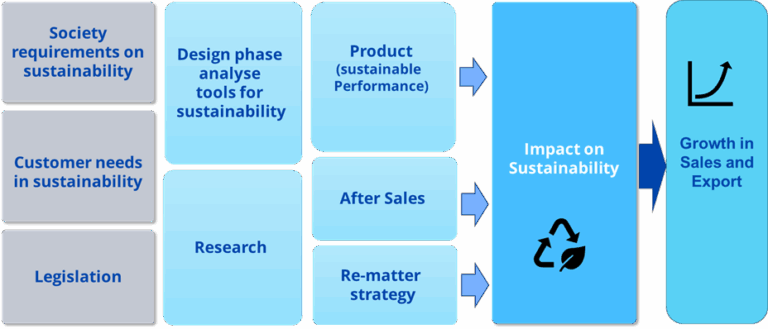
Why SuMEx?
Sustainability is no longer optional — it’s a business necessity. Increasing expectations from customers, legislation, and society are setting stricter requirements for how products are designed, manufactured, used, and recycled. Machine builders must meet these demands by offering solutions that combine performance and environmental responsibility.
Today’s lifecycle assessment (LCA) tools — such as GHG or PEF — are complex, time-consuming, and not suitable for early-phase design. One of SuMEx’s key innovations is a lightweight, easy-to-use carbon footprint calculation model, which allows designers and engineers to quickly assess a product’s carbon impact during the design phase — when decisions matter most.
Who is involved?
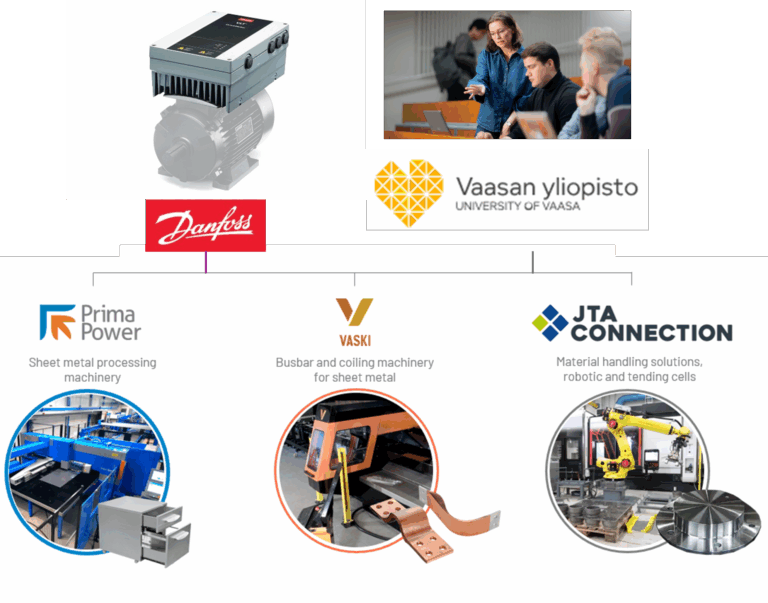
The project is coordinated by DIMECC Oy. Partners include:
- Danfoss Drives – variable-speed drives and power electronics
- JTA Connection Oy – flexible automation solutions
- PrimaPower (Finn-Power Oy) – sheet metal manufacturing systems
- Vaski Group Oy – machinery for busbar manufacturing
- University of Vaasa – research partner and modeling tool developer
- Business Finland is funding SuMEx-Co-Innovation project.
Together, these partners represent the entire manufacturing value chain, enabling broad cooperation and impact.
SuMEx project goals include:
- Understanding customer sustainability expectations
- Developing agile tools for evaluating environmental impact in the design phase
- Creating new product features to reduce energy use, material loss, and improve usability
- Exploring reuse, refurbishment, and circular business models to extend product life and reduce emissions
The University of Vaasa contributes cutting-edge research in supply chain emissions and develops the modeling tools that help companies optimize their environmental performance from a system-wide perspective.
Project Structure – Three Work Packages and Cross-Cutting Themes
WP1: Products & Design
This work package focuses on sustainable product development and digital tools to support it. Key elements include:
- A lightweight carbon footprint calculation tool for use in early design
- AI-powered solutions for material optimization
- Sustainable and user-friendly UI/UX concepts
- Energy-efficient machine design
- Business models leveraging sustainability data
The goal is to integrate sustainability into product design — not as an afterthought, but as a guiding principle from the beginning.
WP2: After-Sales and Services
This work package explores how customer services and aftermarket operations can support sustainability:
- Remote support and monitoring (reducing travel-related emissions)
- Utilization of operational data to improve performance and reduce impact
- Sustainable maintenance and upgrade concepts
Digital services can help extend product life and improve environmental performance over time.
WP3: Re-matters – Lifecycle Extension and Circular Economy
This package focuses on reuse and refurbishment, including:
- Concepts for integrating reused and refurbished components
- Sourcing and validating used parts
- Sustainable business models for circular practices
- Legal and quality considerations
This supports the shift from linear manufacturing to a more circular, resource-efficient approach.
Power of Collaboration
One of SuMEx’s key strengths is its value chain-wide collaboration. No single company can evaluate or reduce environmental impact alone. Materials, components, and processes often come from multiple suppliers. SuMEx develops practical ways to share data and collaborate across the supply chain.
The University of Vaasa contributes state-of-the-art research on emissions modeling, supply chain analytics, and software development. The project is also linked to Danfoss’s Fossil Free Future “Veturi” initiative and the national innovation ecosystem MAKE, coordinated by DIMECC.
Expected Impact
- Partner companies aim to grow combined revenue by €43 million by 2030
- Companies will have tools to measure and reduce the environmental footprint of their products and operations
- Customers benefit from transparent, verifiable sustainability gains, supporting their own climate goals
- Results and tools will be shared more widely, benefiting the entire Finnish industry — some tools will be made publicly available
Facts
Budget 3,5 M€
Duration 2024 – 2026
Contact
seppo.tikkanen@dimecc.com